Bali Tourism Infrastructure
Bali Tourism Infrastructure – Bali’s Governor, Wayan Koster, has been making more frequent visits to Jakarta to discuss increased investment in tourism development and provincial infrastructure with the Indonesian Central Government.
As Bali is one of Indonesia’s largest contributors to the national GDP, Governor Koster believes the province needs more financial support to improve services for both residents and the 7.5 million international tourists who visit each year.
During his visits to Jakarta, Governor Koster shares his concern that Bali Province faces serious challenges if economic constraints are not alleviated quickly.
He made it clear that the level of infrastructure development needed in Bali cannot be funded by the regional budget (APBD) alone, and that the province urgently needs increased funding from the APBN (State Budget).
Speaking from Bali’s Sanur, at Bali Provincial Conference of the Indonesian National Association of Consultants (Musprov Inkindo), hosted at the iconic Prama Sanur Beach Bali.
Governor Koster emphasized that he is actively communicating with the central government as a primary strategy for speeding up development, particularly in the infrastructure sector, which is considered to be lagging behind many other provinces nationwide.
He explained that the Bali Provincial Budget (APBD) currently stands at around IDR 6.8 trillion, a figure considered far from sufficient to finance large-scale development, particularly in the infrastructure sector, alongside all other public services that must be funded from that pot of cash.
Governor Koster explained, “This is why I have to socialize a lot in Jakarta. If I only rely on the regional budget, it’s always the same, boring. There’s no improvement whatsoever.”
He noted that this is an issue he has been circling around for some time, before he was the Governor of Bali. Koster served three terms in the Indonesian House of Representatives (DPR RI), in the Budget Agency, which manages the state budget in the thousands of trillions of rupiah.
He explained, “I was in the Budget Agency, and for three terms in the Indonesian House of Representatives, I managed thousands of trillions. So, Bali’s regional budget can be completed in less than a few days, just an hour. Especially for a mathematician.”
The Governor candidly shared with the conference that he does not want to be a provincial leader who only does administrative work without being able to drive real change.
Governor Koster noted, “If it’s just like this, what’s the point? I don’t want to be just a governor who signs things. I’m a working person. Work, work, and work.”
He continued, “If we only rely on Bali’s local revenue (PAD), which is around IDR 4.5 trillion, we won’t get anywhere. That’s why I keep going to Jakarta. Now we’re starting to get a lot.”
One of Governor Koster’s missions for his term in office is to focus on Bali’s future infrastructure development with a specific focus on improving connectivity between regencies and cities. He aims to complete at least 70 percent of these connectivity infrastructure projects within the next four years, until 2029, before his term ends in 2030.
Governor Koster shared, “Five years is a short time. Now it’s over a year, with four left. So I have to work faster and harder to complete all my big plans.” Adding ”I’m a working person. I go to bed as late as 1 am, sometimes 2 am. My mind is constantly working. I no longer think about the symbols of office.”
Main Article: Bali Tourism Infrastructure
The major projects that he is seeking to see completed by 2030 include the Singaraja–Mengwitani Shortcut Road, the Tohpati and Pesanggaran underpasses, the Karangasem-Buleleng connecting road, and the continuation of the Ida Bagus Mantra Bypass on the Kusamba-Padangbai section.
All of these projects would directly help reduce traffic congestion in key tourist areas and help improve mobility across the province for local residents, as well as the easier transportation of goods.
He is also overseeing project that have already received funding from the central government including the new bridge Nusa Ceningan and Nusa Lembongan, worth IDR 112 billion; the construction of a parking building in the Ulun Danu Batur tourist attraction area, valued at around IDR 250 billion; and the essential construction of a clean water and irrigation network in Kubu District, Karangasem, which has a budget of around IDR 90 billion.
Governor Koster concluded, “I’m 64 now, and I’ll finish at 68. If I live to be 90, everyone will die. So what’s important now is to do good, sincere, and useful work…I’m not going to do anything strange anymore. I just work sincerely and honestly. What matters is the results are for Bali.”
Main Article: Bali Tourism Infrastructure
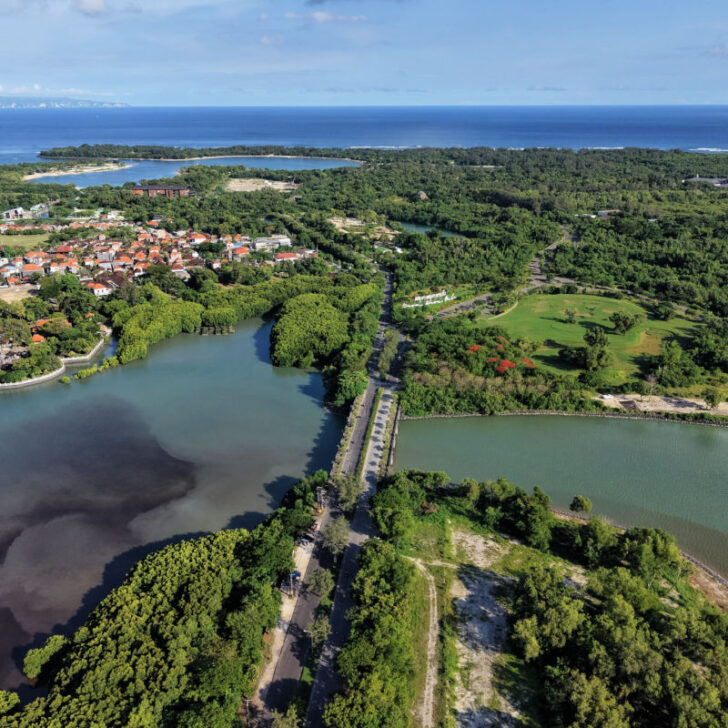
Bali's Growing Trash Issues
Bali’s biggest open landfill, Suwung TPA, is set to close once and for all on the 31st July 2026. The site stopped receiving organic waste as of the 1st April, and it is this that has sparked a fresh round of problems for local communities and business owners within the catchment area.
Suwung TPA receives the majority of the water generated in Denpasar City, including top resorts like Sanur, and Badung Regency, which is home to the island’s busiest resorts like Canggu, Legian, Seminyak, and Uluwatu.
The closing of landfill sites and a shift towards more composting and recycling waste management models is an excellent idea at first glance, but in reality, in Bali, the situation is a little more nuanced.
For Bali, it’s not as simple as switching from landfill to composting and recycling, as the infrastructure to support the switch has not yet been built.
There are a series of small recycling facilities in Bali, both public and private, but even cumulatively, these facilities cannot cope with the volumes of waste produced across the province every day.
Main Article: Bali Tourism Infrastructure
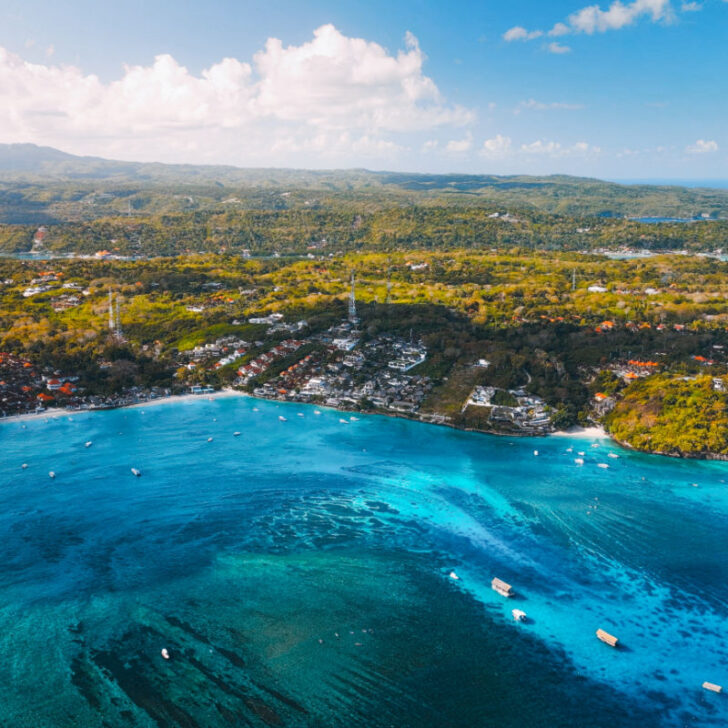
A solution is in sight. The Bali Provincial Government is set to build a Waste to Energy (PSEL) facility that is set to help process the province’s waste more effectively. The issue with that, however, is that construction won’t begin until July 2026 and will take at least 18 months to build. You see the problem here?!
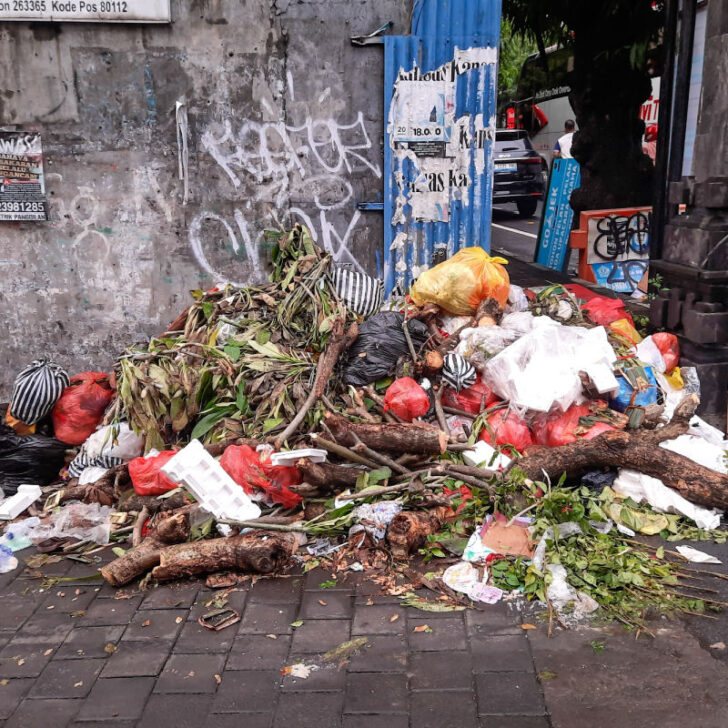
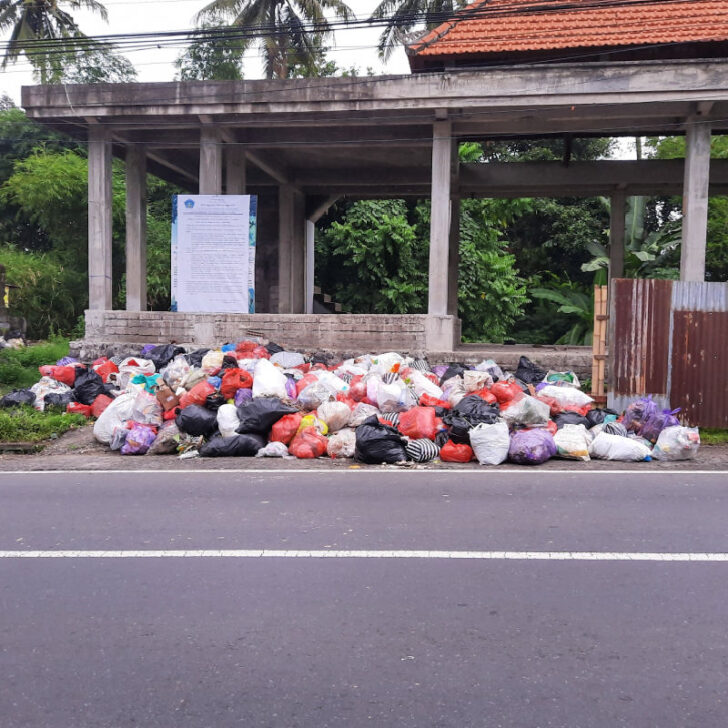
With waste now piling up in communities across the island, and to help tackle the existing issues of waste management, including the dumping of trash in rivers and illegal landfills sites, both local leaders, community activities, private businesses, and NGOs are working to resolve the situation in big and small ways.
Earlier this week, Bali Hotel Association (BHA) and local NGO Sungai Watch installed a new trash barrier along the river in the Banjar Kancil area of Kerobokan, close to Canggu. These river barriers have proven to be a simple but highly effective way to trap tier trash so that it can be removed from the waterways.
Speaking to reporters, BHA’s Head of Sustainability, Ankit Airon, shared, “This is the result of the contributions of all BHA members who have come together to support Sungai Watch and Bali.”
He confirmed that Sungai Watch is responsible for the operation and management of waste retained at the barrier.
Waste will be removed periodically to prevent accumulation at the site. Airon shared, “Usually, around 300 to 350 kilograms of waste are collected every two to three weeks, depending on the amount of waste retained.” Adding “The plastic is reprocessed through the Sungai Design unit into reusable products, such as furniture and other equipment.”
Main Article: Bali Tourism Infrastructure
”We work closely with Sungai Watch because they have data and understanding of the amount of waste at each location. From there, we determine the points that need it most.”
Speaking separately, the Speaking Manager of the Sungai Watch Facility in Denpasar, Iqbal Rizali, said the Kerobokan area is one of the areas with the highest volume of waste, making it a strategic location for installing barriers. He shared, “This net was installed about two to three years ago and has proven effective. In one month, it can capture around 400 to 600 kilograms of inorganic waste.
It is not only the Bali Hotel Association (BHA) and Sungai Watch who are working together to help mitigate the trash problem for Bali, but members of the Indonesian Hotel and Restaurant Association (PHRI) Bali, too.
A group of 5-star and 4-star hotels in the Badung Regency area has confirmed that they will be pooling funds to purchase an organic incinerator that will help process organic waste to compost in under six hours. Hotels, restaurants, and cafes contribute to 30-40% of the total waste produced in Denpasar and Badung Regency, and so this will go a long way in helping remove organic waste from the system in the short and long term.
Bali Immigration Updates
Bali Immigration is working around the clock to crack down on foreigners breaking immigration law. Bali welcomes more than 7 million international tourists each year, and while the vast majority of visits honor the laws of the land, an increasing number of individuals are being caught breaking immigration law in big and seemingly small ways.
To help clear up any claims of a grey area, the Indonesian Immigration has issued updates on ‘unpaid activity’ that foreigners may engage in during their time in the country. Unpaid activities can include skills exchanges such as hairstyling for a wedding, teaching yoga in exchange for a free place on a retreat, a language exchange, or music and DJing.
This is a particularly important clarification for those planning on engaging in influencer and content creation projects, both as individuals, in unpaid collaborations, and formal paid partnerships.
At first glance, visitors to Indonesia may think that these are simple volunteering or free skills exchanges that have nothing to do with immigration status, but nothing could be further from the truth. In the eyes of the Indonesian Immigration, these activities could violate the conditions of an individual’s visa stay permit.
The key thing visitors to Bali need to be aware of is the purpose of the visit and whether the unpaid activity has any economic value.
If the unpaid activities do not align with the purpose of the visit stipulated on the visa or stay permit, this is considered an immigration violation. Indonesian Immigration explains, “Is unpaid activity always allowed?” The answer to which is “Not always. Immigration authorities may look at the purpose of stay, the type of activity, and whether there is economic value behind it.”
Indonesian Immigration continues to answer the question, “What activities may raise concern?” The team has specifically highlighted four increasingly common situations. These are “professional services like makeup artists or photographers. Commercial promotion, such as endorsing products or services. Content creation for business, like creating social media content with promotion. Work-like activities that involve benefits, even if unpaid.”
Indonesian Immigration clarifies, “Indonesian immigration law mandates that foreign nationals use their visa and stay permit in accordance with the intended purpose. Activities inconsistent with the granted visa may result in sanctions.”
For further clarification, the Indonesian Immigration has shared a case study.
The team explained “Case Study: Free Makeup for Social Media. A foreign national enters Indonesia on a visit visa and provides free makeup services for social media content. The content is later used for portfolio or promotional purposes. Even without direct payment, it may be deemed to have economic value.”
Indonesia Immigration adds, “Compliance is key. Unpaid activities do not automatically qualify as permissible. If there is work, service, promotion, or economic benefit involved, the activity must align with the visa and stay permit used.”
Main Article: Bali Tourism Infrastructure
To put it another way, if work, service, promotion, or economic benefit is involved, for either party in the exchange, a visit visa (including tourist and socio-cultural visas) is not the appropriate visa for the individual.
If a foreigner wants to enter Bali for activities that involve work, service, promotion, or economic benefit, it is important to opt for the correct visa; this could be a work permit, investment visa, business visa, volunteer visa, or artists and performers visa.
All of these cover leisure, travel, and recreation as included activities. The difference is that tourism and socio-cultural visas do not permit activities that involve work, service, promotion, or economic benefit.
The Indonesian Immigration website makes it incredibly easy for foreigners to understand which visa is most appropriate for their visit.
The Official Indonesia eVisa website narrows down the visa options for applicants, starting with the main purpose of their visit, followed by the sub-purpose of the visit.
The site also has a live chat option where applicants can connect with an Immigration officer who can issue advice on their specific situation.
Main Article: Bali Tourism Infrastructure
All above articles are provided by “The Bali Sun“